
Indonesia's DPI landscape can be explored through three shared capabilities: proving identity, moving money and exchanging information. Dukcapil and IKD, QRIS and BI-FAST, SATUSEHAT and SPLP provide concrete examples. Each serves a different function through its own institutions and participation rules.
Their value becomes visible in everyday transactions: a merchant accepting payments across providers, a patient continuing treatment or a resident applying for assistance. The next question is how these capabilities help people complete services across institutions.
Indonesia at a glance
| Capability | Main examples | Progress to examine |
|---|---|---|
| Identity and access | Dukcapil population records; IKD | Enrolment, acceptance and successful service use |
| Payments | QRIS; BI-FAST; SNAP | Provider interoperability, transaction reliability and merchant experience |
| Data exchange | SATUSEHAT; SPLP | Authorised exchange, usable records and service completion |
| Supporting ecosystem | INApas; OSS/NIB; Satu Data Indonesia | Access, authoritative evidence and consistent data governance |
Identity: from a population record to service use
Dukcapil maintains population-administration foundations. Identitas Kependudukan Digital, or IKD, provides a digital identity application within that environment. An official Banda Aceh Dukcapil report relaying national figures records 22.48 million activations as of 14 September 2026. 1
Activation is one milestone. Useful service evidence includes where the identity is accepted, whether authentication succeeds and how mismatched records are corrected. Institutional use of Dukcapil data should be distinguished from transactions using the IKD application itself.
Payments: three complementary functions
QRIS is Indonesia's common QR payment standard. Participating providers can support merchant payments without requiring the customer and merchant to use the same application. BI-FAST provides real-time retail payment infrastructure available around the clock. SNAP standardises payment APIs, including technical, security and data requirements; its management was transferred to ASPI in September 2023. 2, 3, 4
Bank Indonesia figures reported by ANTARA show 65.77 million QRIS users and 44.86 million merchants as of June 2026, with 96.68% of merchants classified as MSMEs. These measure reach; active use and transaction quality require separate evidence. 5
QRIS, BI-FAST and SNAP perform different jobs. A QR standard, transfer infrastructure and API standard should be understood separately when mapping a service.
Data exchange: health and government services
SATUSEHAT: information for continuity of care
SATUSEHAT Platform is the Ministry of Health's health information exchange, connecting participating health systems. Its documentation specifies HL7 FHIR for data models and APIs. SATUSEHAT Mobile is a public-facing application within the wider ecosystem. 6
The practical test is whether relevant information is accurate and available to an authorised provider when needed. A connected facility and a completed exchange do not alone establish an improvement in treatment or continuity of care.
SPLP: exchange across institutions
Sistem Penghubung Layanan Pemerintah, or SPLP, supports exchange between government systems. Komdigi's August 2026 account describes its use in the Digital Social Protection pilot, allowing verification to draw on records held by responsible institutions. 7
That account makes a useful distinction: SPLP supports information exchange; the Ministry of Social Affairs retains authority over eligibility. Technical connectivity and programme decisions have different owners. The documented pilot should be distinguished from universal integration across government services.
The wider ecosystem
INA DIGITAL / INApas: INApas is intended to support digital identification and access to government services. Its official site, checked for this page, still describes a limited release. Availability should be stated for the specific service and rollout stage. 8
OSS and NIB: the Online Single Submission system supports business licensing, with Nomor Induk Berusaha as an official business identity. It provides an important context for business evidence, while receiving programmes define which records and conditions they accept. 9
Satu Data Indonesia: this government data-governance initiative supports data quality, accessibility and reuse. Its portal is a reference for open government data. It should be distinguished from permission to access personal records in a service transaction. 10
These programmes occupy different roles: access, licensing and data governance. Their inclusion in the landscape does not mean they are automatically connected to every shared capability.
What progress should mean next
For MOSAIC Wiki, four questions connect the landscape:
- Useful reuse: does another institution accept existing evidence and reduce repeated submission?
- Accountability: who maintains the record, makes the decision and resolves an error?
- Inclusive access: can someone complete the service with limited connectivity, an inaccessible interface or a lost device?
- Measured value: do time, cost, rejection and correction outcomes improve against the current process?
Proposed learning case: map a small business applying for support. Identify the personal identity check, business record, eligibility decision and payment step. Explore whether signed credentials or authorised queries could reuse evidence. Agree issuer authority, validity, updates and correction routes before testing.
This is a proposed service exercise. It does not assert an existing IKD-OSS-QRIS integration or assume that business registration establishes eligibility for assistance or credit.
Illustrative landscape map
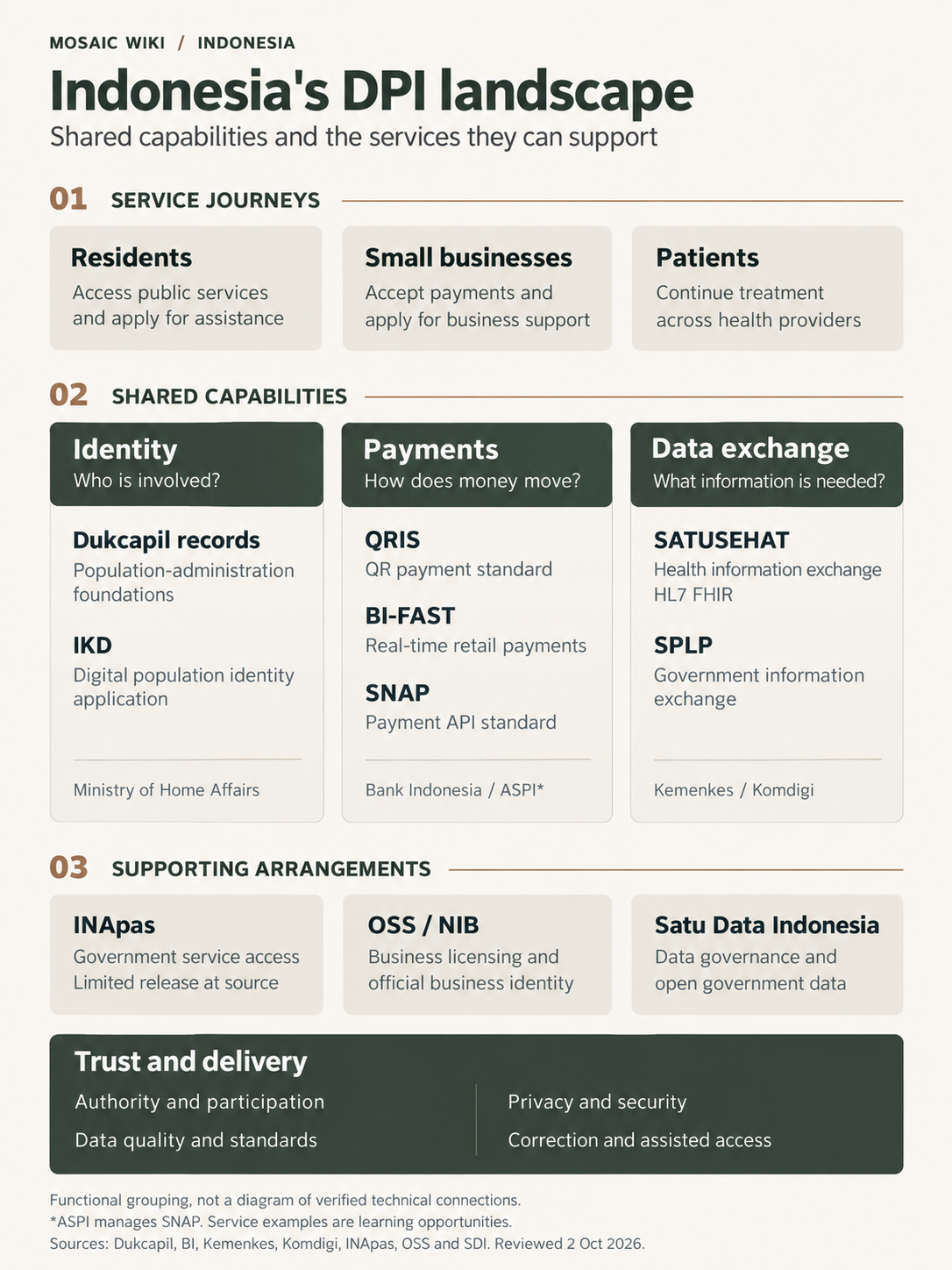
Read the map by function. The grouping shows where selected capabilities fit; it does not represent verified technical connections between all named systems. The service examples indicate learning opportunities.
Sources and further reading
- 1 Dukcapil: September 2026 activation and population-services report.
- [2-5] Payments: BI QRIS overview, BI-FAST overview, SNAP standards, SNAP management update and ANTARA's report of BI adoption figures.
- 6 Health exchange: SATUSEHAT introduction and FHIR documentation.
- 7 Government exchange: Komdigi's SPLP and social-protection pilot account, 15 August 2026.
- [8-10] Supporting programmes: INApas, OSS and Satu Data Indonesia.