

Convening synthesis
Beyond Interoperability
How We Built Together
Shared infrastructure depends on institutions being able to rely on arrangements outside their own systems. MOSAIC's first convening examined what makes that reliance possible. The discussion informs three commitments that will guide how we develop collaborative pilots and assess whether they offer a basis for wider use.
i. Use pilots to test the roles and rules of sharing
A pilot gives institutions a practical setting in which to work out the terms of sharing. For MOSAIC, that means examining how responsibilities, agreements and decisions hold up in an actual service, alongside the performance of the technology.
Shared definitions and reference data are part of this work. Recognising the same facilities, practitioners or businesses allows institutions to use information consistently while retaining their own decisions. Our pilots will explore what needs to be common, what remains within each institution's authority, and the terms on which one can rely on another's evidence.
An agreed scope, permissions and safeguards provide the starting conditions. Experience can then reveal where procedures need to change, where responsibilities remain unresolved, and what wider adoption would require. Documenting those findings, including costs and limitations, gives another institution a basis for deciding what it could reuse and what it would need to adapt.
ii. Clarify the economics of sharing
Shared infrastructure depends on actors having reasons to participate and remain involved. Businesses contributing to Digital Public Infrastructure (DPI) bring commercial interests that shape what they can offer and sustain. Understanding those interests is part of establishing workable cooperation.
The economics of sharing therefore concerns benefits as much as costs, responsibilities and risks. Participants may contribute in different ways and receive different forms of value: lower operating costs, access to new markets, more reliable evidence or opportunities to develop services. Our role is to help partners make those contributions and benefits explicit, and examine how the arrangements support both participation and public value.
These interests do not have to be identical. A workable arrangement allows participants to pursue their interests in ways that reinforce the purpose of the shared infrastructure. Clear terms give each actor a basis for understanding what they gain, what they take on and what they can expect from others. That provides a stronger foundation for sustained participation.
iii. Build the trust ecosystem that supports adoption
Pilots can make the roles and rules of sharing testable. Clear economic arrangements give actors reasons to participate. Together, these provide part of the foundation for a trust ecosystem in which institutions can rely on evidence, services and processes beyond their own systems.
Adoption depends on whether institutions have a credible basis for that reliance and the capacity to change how they work. For MOSAIC, this means working with the people who establish procedures, accept another institution's evidence, allocate resources and handle failures. Their experience helps establish workable terms, including which responsibilities are shared and who remains accountable for each part of the service.
Continuity is part of that work. Ownership, stewardship, maintenance and the retention of operational knowledge influence whether the service can continue through changes in leadership or operators.
The trust ecosystem is a substantial area of work in its own right and warrants a separate discussion. It encompasses questions of who is recognised as a trusted actor, how that recognition is maintained or withdrawn, what assurances others can rely on, and how errors and disputes are resolved. The allocation of authority and accountability across these relationships deserves closer examination than this synthesis can provide.
Our pilots offer a practical setting for identifying those questions and examining particular arrangements. Making their assumptions and limits explicit will help define the wider work needed to sustain cooperation across institutions.
Putting the Commitments to Work
MOSAIC approaches these commitments through its five-stage working framework. Each implementation offers evidence and practical foundations for wider learning, reuse and adaptation.
01 — Identify An institution brings a problem it needs to solve. Mosaic documents it with evidence and maps what shared infrastructure could replace.
02 — Convene Mosaic assembles the institution that owns the problem, the team that can build the answer, and the funder prepared to underwrite it. They agree what would count as success before anything is built.
03 — Pilot A working version is tested in one real service, before anyone commits to it as policy or as a standard.
04 — Publish The design, the evaluation and the result are released openly, including where the approach failed, so the next country starts from evidence rather than from scratch.
05 — Propagate The components validated in one sector are built to be reused, not rebuilt. Mosaic shapes them into a shared framework other sectors can adopt directly, so growth means extending the same rails instead of laying new ones.
↩ Propagate becomes the next Identify, and the cycle repeats.
Where the Work Could Begin
The pre-read introduced three candidate use cases as starting points for discussion. They remain possible applications for these commitments; the participating people, resources and institutional decisions for each still need to be agreed.
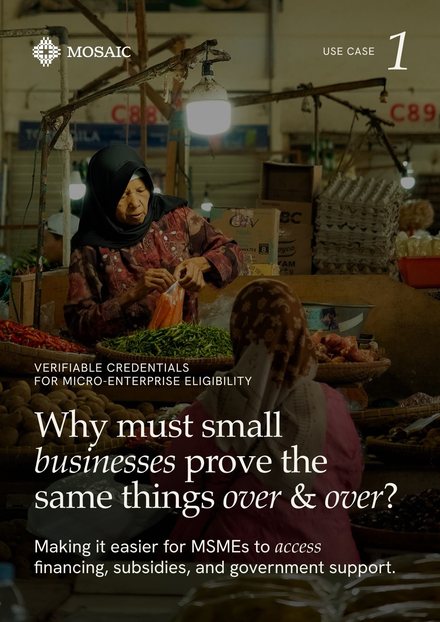
Reusable credentials for small businesses
Trusted evidence could be presented for loans, subsidies and grants without repeatedly submitting the same documentation.
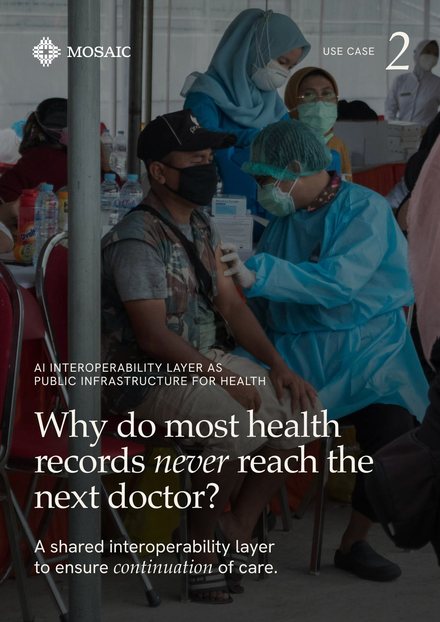
Health information that supports continuity of care
AI-supported interoperability layer of clinical notes exchange, with clinical review, could make health information more useful across healthcare facilities.

Selective disclosure for public entitlements
People could prove eligibility without disclosing an entire personal record, with accessible alternatives for those who need support.
The Next Step
MOSAIC will work with interested partners to develop a first pilot proposition around a defined service problem. The three commitments will shape what that proposition must resolve:
The undertaking The service problem, intended beneficiaries, improvement sought and components available for reuse.
The responsibilities Roles, contributions, expected benefits, operating responsibilities and institutional decisions still required.
The evidence Establishment and operating costs, prospects for continued operation, and how benefits, results and limitations will be assessed.
A successful pilot should leave behind more than a working solution. It should give other institutions the evidence and practical guidance to assess whether and how they can adopt it.
Gallery
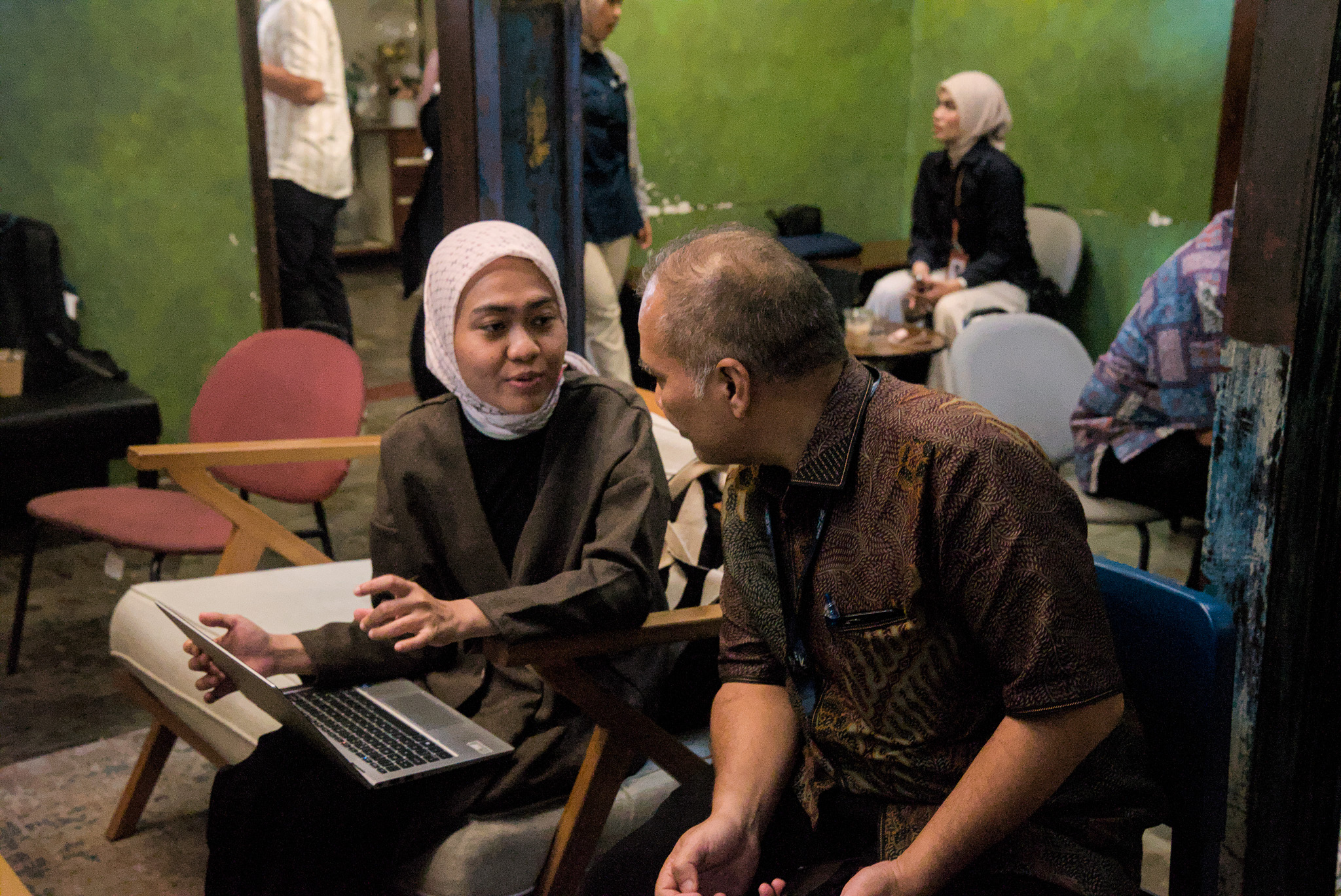
From the Convening
Moments from MOSAIC's first gathering of institutions, builders and partners.










Continue the Conversation
Shared infrastructure requires institutions willing to work beyond their own boundaries.
MOSAIC DPI Alliance welcomes institutions, builders, funders, and ecosystem partners interested in contributing expertise, development capacity, institutional participation, or funding.